Two patients can have the same spine procedure and still have very different recoveries. More and more research suggests that part of the reason lies outside the operating room, in what experts call social determinants of health. These are the conditions people live in, like income, housing, education, transportation, and support at home.
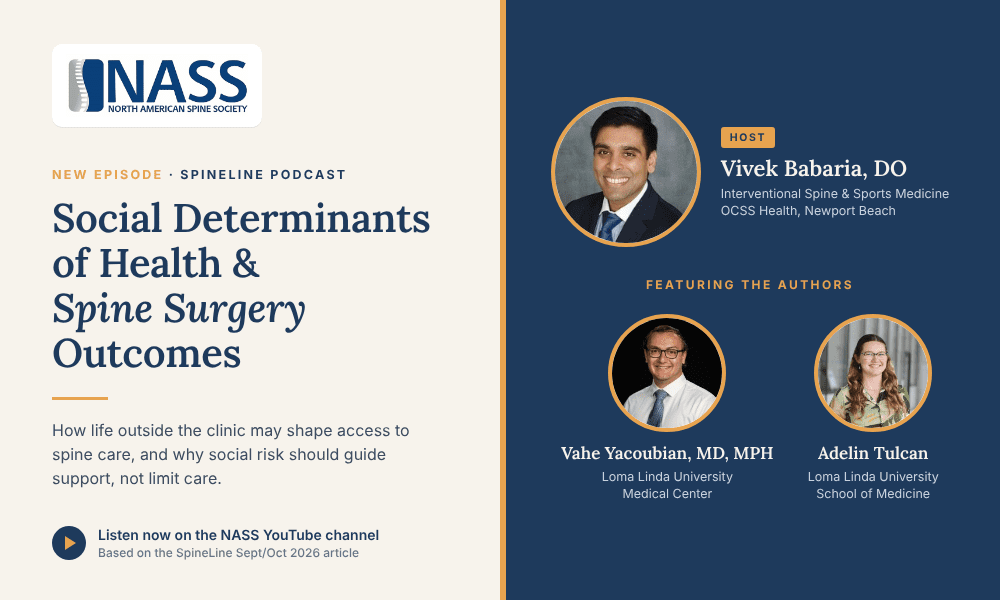
That was the focus of a recent episode of the SpineLine Podcast from the North American Spine Society (NASS), hosted by Dr. Vivek Babaria, DO, a member of the NASS Public Outreach Committee. Dr. Babaria spoke with Dr. Vahe Yacoubian, MD, MPH, of Loma Linda University Medical Center, and Adelin Tulcan of Loma Linda University School of Medicine. They discussed their SpineLine article, “Social Determinants of Health and Spine Surgery Outcomes: A Literature Overview,” co-authored with Dr. Olumide Danisa, MD, of Duke University Medical Center.
Recovery happens in real life
Dr. Babaria opened the conversation with a simple question: “What does social context add to the usual clinical assessment, and why is it particularly relevant to spine recovery?”
“I think treatment is half the battle,” answered Dr. Yacoubian. The other half is the life a patient returns to after treatment. As he explained, spine patients “require tremendous support after procedures. They need to draw resources and strength from their communities.”
How social factors shape access and recovery
The authors reviewed research showing that socioeconomic barriers may delay when patients first see a spine specialist. Transportation, distance to care, and household circumstances can all play a role. Patients who arrive later may have more pain and less function at the time of surgery.
After surgery, the research points to longer hospital stays, more discharges to skilled nursing facilities, and higher readmission rates for patients facing greater social disadvantage. Studies suggest these patterns can hold even after accounting for age, other health conditions, and surgical complexity.
Four tools for measuring social risk
Researchers use community-level scores to estimate social risk. The article reviews four of them:
- SVI (Social Vulnerability Index): looks at socioeconomic status, household characteristics, minority status, and housing and transportation
- ADI (Area Deprivation Index): measures neighborhood resources like income, education, employment, and housing
- DCI (Distressed Communities Index): focuses on local economic distress
- SDI (Social Deprivation Index): reflects everyday obstacles, including access to a vehicle
These scores describe communities, not individuals, and they are designed to support clinical judgment, not replace it.
A reason to support, not a reason to say no
The central message of the episode: social vulnerability should never mark someone as a poor surgical candidate. Instead, it may help care teams spot patients who could benefit from early care coordination, social work support, discharge planning, and tailored education.
“The entire point of the indices is to not reduce the patient population eligible for said procedures,” said Ms. Tulcan, “but rather expand thought on how to tackle these potential post-operative outcomes.”
Looking ahead
The conversation also looked ahead to how AI and future payment models might help direct resources to the patients who need them most. “Just because it’s hard doesn’t mean we have to avoid hard things,” said Dr. Babaria.
Ms. Tulcan closed with a thought worth remembering: “Being there in the office is hard, but for them, coming to the office is harder.”
Watch and read more
Watch the full episode on the NASS YouTube channel: https://www.youtube.com/watch?v=JX7C6cExBrQ
Read the article in SpineLine: https://spinelinemag.spine.org/septoct26/invited-review
Frequently Asked Questions
What are social determinants of health?
Social determinants of health are the conditions people live in that can affect their health. They include income, education, housing, transportation, and support from family and community.
How might social factors affect spine surgery recovery?
Research suggests social and economic barriers may delay when patients first see a spine specialist and may be linked to longer hospital stays, more skilled nursing discharges, and higher readmission rates. These patterns may reflect barriers to recovery, not problems with the surgery itself.
Does a high social vulnerability score mean someone shouldn’t have spine surgery?
No. The researchers stress that social vulnerability should not be used to label someone a poor surgical candidate. Instead, these scores may help care teams identify patients who could benefit from added support before and after treatment.
What are SVI, ADI, DCI, and SDI?
They are community-level scores researchers use to estimate social risk. Each one looks at a different mix of factors, such as income, education, housing, transportation, and local economic conditions. They describe communities, not individual patients.
Who hosted the SpineLine podcast episode?
Dr. Vivek Babaria, DO, a member of the NASS Public Outreach Committee and an interventional spine and sports medicine physician at OCSS Health in Newport Beach, hosted the episode with guests Dr. Vahe Yacoubian and Adelin Tulcan of Loma Linda University.
How can I schedule a visit with Dr. Babaria?
OCSS Health has offices in Newport Beach and Huntington Beach. Call (949) 216-5277 to schedule a visit.